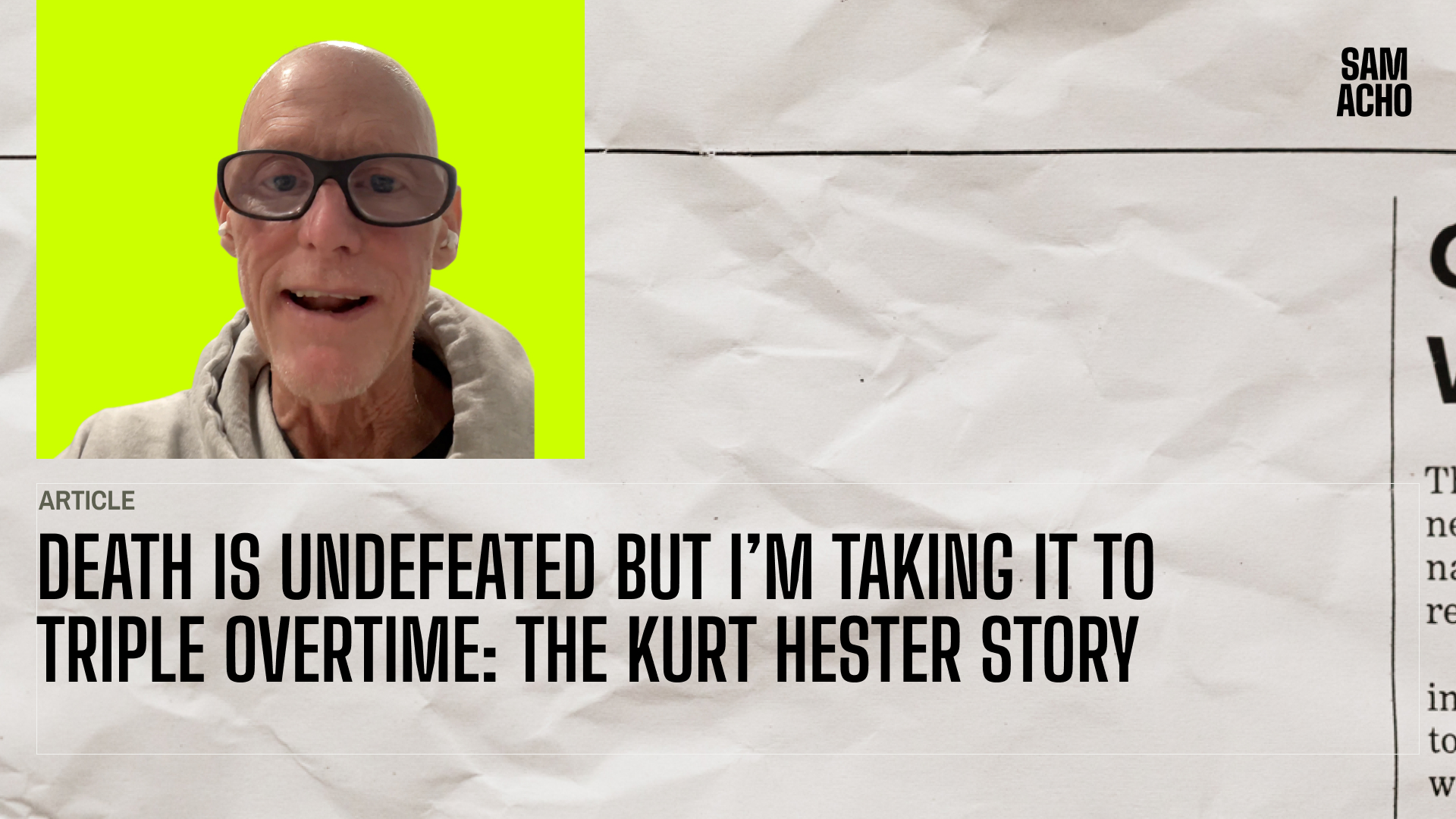
Kurt Hester’s story begins on the Louisiana coast and testifies to a brand of strength shaped by blue-collar roots, a world championship cancer fight, and the realization that true impact lives on in relationships.

On episode 17 of the podcast, Clif and I got to sit down with one of the greats: Kurt Hester. To call his story inspiring is a wild understatement. For anyone facing adversity or looking for encouragement, this post is for you.

Raised in the swamp and shaped by fire

Kurt Hester grew up where the land is more water than earth, and family meant working the boats, speaking Cajun French, and loving hard. In his world, you either fought the Gulf for a living or you played football. College was for outliers; “you were not a man if you didn’t work on a shrimp boat or in the oil field,” he says. From childhood, he waded deep into cypress swamps, caught alligators, and learned to stay calm in wildness. At the bus stop, Kurt and his friends brawled for fun—“We’d be all bloody, shirts ripped off, and then we’d just go to school.”

While his roots held a family of faith—his mother ordained, his great-grandfather the region’s first Protestant preacher—Kurt found his pulpit with iron. “I’m the minister of iron,” he told his mom, owning the calling his bones understood. That blue-collar mentality never left him. Peace still comes in quiet moments near the swamp, the place others called ugly but he claims as sanctuary.

Every day is a championship fight

Stage four. Lungs and liver. Tumors pressing on his chest, swelling his belly. Doctors said experimental drugs, offered one new hope after another, and finally, one told him, “Go home, make peace, and call hospice.” Kurt almost laughs retelling it: “You won’t break me.” This world championship fight is “greater than the Super Bowl, greater than the Olympics.” For him, quitting was never an option. He never asked, “Why me?” He went to work—reading five, six oncology books, concocting a regimen of supplements, red light therapy, hyperbaric oxygen, and anything else that might knock down inflammation, buy another week.

Routine matters. Up at 4:00 a.m., training because there’s no energy left later. Diet stripped down: almost no sugar, little protein, raw vegetables, “and I don’t know how vegetarians aren’t angry all the time.” He jokes about homemade “Alka-Seltzer” drinks and “lifting anyway, even if the doctor says not to.” Every movement counts. If he can move, he can fight. The day he couldn’t squat the bar haunted him until he hit new numbers, sharing each milestone as a “thank you” to those cheering him on.

Coaching is measured in lives touched

The scoreboard doesn’t tell the real story. Letters, messages, and calls arrived from every corner—athletes he’d trained, coaches abroad, old friends. “I never realized how many people I impacted,” he admits, his voice raw. Support overwhelmed him; answering messages became a full-time job. But those relationships, not trophies, became his wealth.

Clif Marshall’s mantra—“Results are temporary. Relationships are eternal.”—echoes in every story Kurt tells. Awards and records fade. What endures is the teammate who calls after decades, the athlete who says his life changed in the weight room, the friends who rally when stakes are highest. Kurt’s gratitude is simple. “The only way I can pay them back is to not die—to keep lifting, keep moving, and let them see it’s possible.”

Faith, connection, and the next play

Adversity pulled Kurt back to his faith. Church became a lifeline, daily Bible study an anchor. He’s planning to be baptized again, this time as a deliberate choice—a marker for the next stage. “When the stairs feel impossible, I just ask God to get me up them.”

Legacy, for Kurt, is as real as those Louisiana swamps: scarred, beautiful, honest. The question left hanging isn’t how much you’ve won—it’s this: Who are you holding up today, and who’s holding you up for the next rep?

Transcript

Listen, Learn, explore

Podcast
00:00 Min
September 7, 2026

Close Space, Not Give Space: The Mindset Behind Elite Pass Rushers

Close Space, Don’t Give Space: Ben Creamer on Performance, Faith & Facing Pressure What does training elite athletes have to do with how we handle pressure in everyday life? Quite a lot, as it turns out. In this episode of the Sam Acho Podcast, Sam Acho and Clif Marshall sit down with Ben Creamer, Director of Sports Science for the Washington Huskies football team and a longtime friend and colleague of Sam and Clif. Ben shares what he has learned from years of working with athletes and explains why great performance coaching starts with relationships. For him, the job isn’t simply about making athletes faster, stronger, or more successful. It’s about being part of their journey as they grow from teenagers into young men and learning how to balance that demanding career with being present for his wife and three daughters. The conversation also takes a fascinating turn into hand-to-hand combat and pass rush training. With a background in taekwondo, wing chun, judo, and boxing, Ben explains how Clif encouraged him to bring those skills into football. His approach is simple but powerful: close space, don’t give space. Instead of instinctively pulling away when an offensive lineman reaches for you, the goal is to move toward the challenge, control the space, and make the opponent react to you. Ben explains how repeated movements can train athletes to overcome the natural flinch reflex until their reactions become instinctive. That lesson extends far beyond football. Ben also takes us inside the world of **sports science**, explaining how GPS tracking, force plates, and other technology help coaches understand an athlete’s workload and physical response. But despite all the data, he believes technology should support good coaching—not replace the human judgment that comes from knowing your athletes. The conversation becomes even more personal when Ben talks about moving his family across the country, the loneliness that came with the transition, and a dramatic car accident where he pulled a man from a burning vehicle. For Ben, the experience became a powerful reminder of purpose and the importance of being present when someone needs you. Sam and Ben then explore **faith, fatherhood, approval, and grace**, including the pressure many of us put on ourselves to perform in order to feel worthy. Their conversation challenges that idea and points toward something deeper: faith isn’t about constantly trying to earn approval. It’s about relationship, presence, and understanding grace. From elite football training to fatherhood and faith, this episode keeps coming back to one powerful idea: When pressure comes, don’t give space. Face it. Because sometimes the way we learn to face an opponent on the field is the same way we learn to face adversity in life.
View
Podcast
00:00 Min
September 1, 2026

Trayce Jackson-Davis on NBA Pressure, Faith & What Really Happened on That Wembanyama Dunk

What happens when the game you’ve dreamed about your entire life becomes harder than you ever expected? NBA forward Trayce Jackson-Davis joins Sam Acho and Clif Marshall for a candid conversation about the realities of life as a professional athlete—and the lessons that come with it. From his days as an Indiana Hoosier to the NBA, Trayce opens up about the highs and lows of his journey, including his sophomore slump, dealing with criticism and hate mail, making the jump to the NBA, and adjusting to life in Toronto. He also takes us behind the scenes of one of basketball’s biggest viral moments: his unforgettable dunk over Victor Wembanyama, But this conversation goes far beyond basketball. Trayce talks openly about mental health, faith, family, NIL, the transfer portal, and the importance of having people around you who will tell you the truth even when you don't want to hear it. He shares what he learned from his NBA mentors, why game-day chapel remains important to him as a professional, and how his younger brother Tayvin’s football journey has brought a whole new perspective to family and competition. At the heart of the conversation is a powerful question: How do you win without losing it all? Trayce’s answer comes down to perspective, gratitude, and remembering that there is always more to life than the scoreboard. This is an honest look at NBA life, adversity, faith, mental health, and what it really means to keep growing when the pressure is on.‍
View

Join Sam’s Journey Today.

Stay up to date with what sam acho is getting up to, his thoughts, new projects, and words of wisdom.

Thanks! You're on the list!
Sorry, something went wrong while submitting the form.
image of person at top of staircase